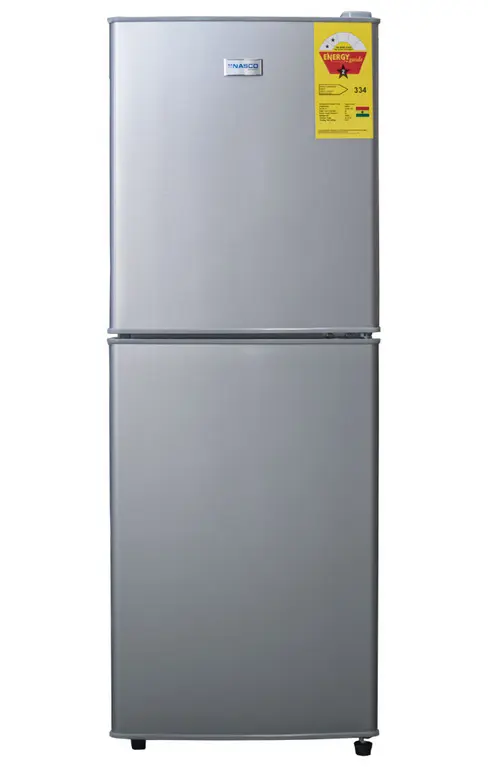
This model is ideal for smaller households or as a secondary fridge for compact spaces (apartments, offices, etc.). The bottom freezer design means the freezer compartment is lower down, which helps with ease of access to the fresh-food section.
Key Specifications & Features
Here are the technical and practical specs drawn from various vendor sources in Ghana:
Specification
Detail
Fresh-Food (Refrigerator) Capacity
≈ 60 L (or ~88 L in some listings)
Freezer Capacity
≈ 56 L (or ~28 L in some listings)
Defrost System
Manual defrost
Cooling Type
Direct cooling
Energy Efficiency Rating
• One vendor says about 2-star rating. • Others list “A+” or use “energy efficient” in descriptions. (There is some inconsistency in listings)
Energy Consumption
~ 334 kWh/year in one source.
Noise
Low noise (quiet operation) is listed among features.
Exterior / Materials
Often in silver, stainless steel or “silver VCM” finish in listings. (electrolandgh.com)
Interior Features
Adjustable shelves, crispers (fruit and vegetable drawer), interior light.
Dimensions (WxDxH)
Approx. 720 × 720 × 1125 mm in one listing.
Other
CFC-free refrigerant, 100% CFC free is among the specs.
Strengths / Advantages
From what is known, the NASD2-14FL offers a number of positives:
Bottom Freezer Design
This makes the fresh food section (which is accessed more frequently) higher up and more ergonomic. Less bending, easier reach for daily items.
Freezer items are a little less convenient to reach but acceptable for occasional use or frozen storage.
Compact Size & Moderate Capacity
116 L is modest but practical for small households, flats, or use as a secondary fridge.
The unit doesn’t take up overly large space given its dimensions (~1.125 m tall). Good for smaller kitchens.
Energy / Power Considerations
It uses direct cooling, manual defrost, which tend to consume less energy under some conditions.
Low noise and energy-saving features are helpful in Ghanaian settings where electricity cost and stability are concerns.
Value Features
Adjustable shelves, crispers, interior lighting—all helpful for storage flexibility and usability.
Silver / stainless or silver finish gives a more modern look.
CFC-free refrigerant is better environmentally.
Weaknesses / Possible Limitations
As with any appliance, there are trade-offs. Based on info and general refrigerator knowledge, here are potential drawbacks:
Manual Defrost
Manual defrost means that you’ll have to periodically unplug or turn off and defrost the freezer. That’s somewhat inconvenient relative to frost-free models.
Energy Rating Ambiguities
Some listings conflict: some say “2-star”, others “A+”. The actual running cost might thus vary depending on exact model batch or supply.
If electricity supply is erratic, energy rating matters a lot. Real-world performance under load may differ.
Limited Freezer Space
With about 28-56 L in the freezer (depending on the listing), this isn’t ideal for heavy frozen storage (e.g. large volumes of meat, bulk freezing). More suitable for lighter usage.
Bottom Freezer Convenience vs Frequent Freezer Use
If you use frozen food a lot, bending down each time may become inconvenient.
Door Swing / Placement
It may have a fixed door orientation (or maybe reversible in some cases), but depending on your kitchen layout, space for opening doors fully must be considered.
Defrost, Cooling-Uniformity & Shelf Layout
Direct cooling models sometimes have less uniform cooling compared to more sophisticated frost-free or multi-air-flow types. Hot spots might occur.
Shelf material / spacing may limit large items.
Usage Tips to Maximize Performance
To get the best out of this model, consider the following:
Placement & Ventilation
Leave adequate space around the sides, top, and back for ventilation (heat from the compressor must dissipate).
Avoid placing it close to heat sources (sun, stoves).
Set the Thermostat Properly
Use the thermostat setting that maintains safety without over-working the compressor. Don’t set freezer/fridge colder than needed.
Defrost Regularly
Because this is not frost-free, ice buildup reduces efficiency. Keep freezer walls relatively frost-free.
Load Smartly
Don’t overfill the freezer or fridge as that impairs airflow.
Place items used frequently in easy-reach areas.
Use the crisper drawer for fruits/vegetables, and keep door shelves for condiments etc.
Power Stability
Use voltage stabilizer/surge protector if electricity supply fluctuates, to protect compressor.
Try to avoid extended power cuts if possible; once power returns, avoid immediately overloading the fridge with room-temperature food.